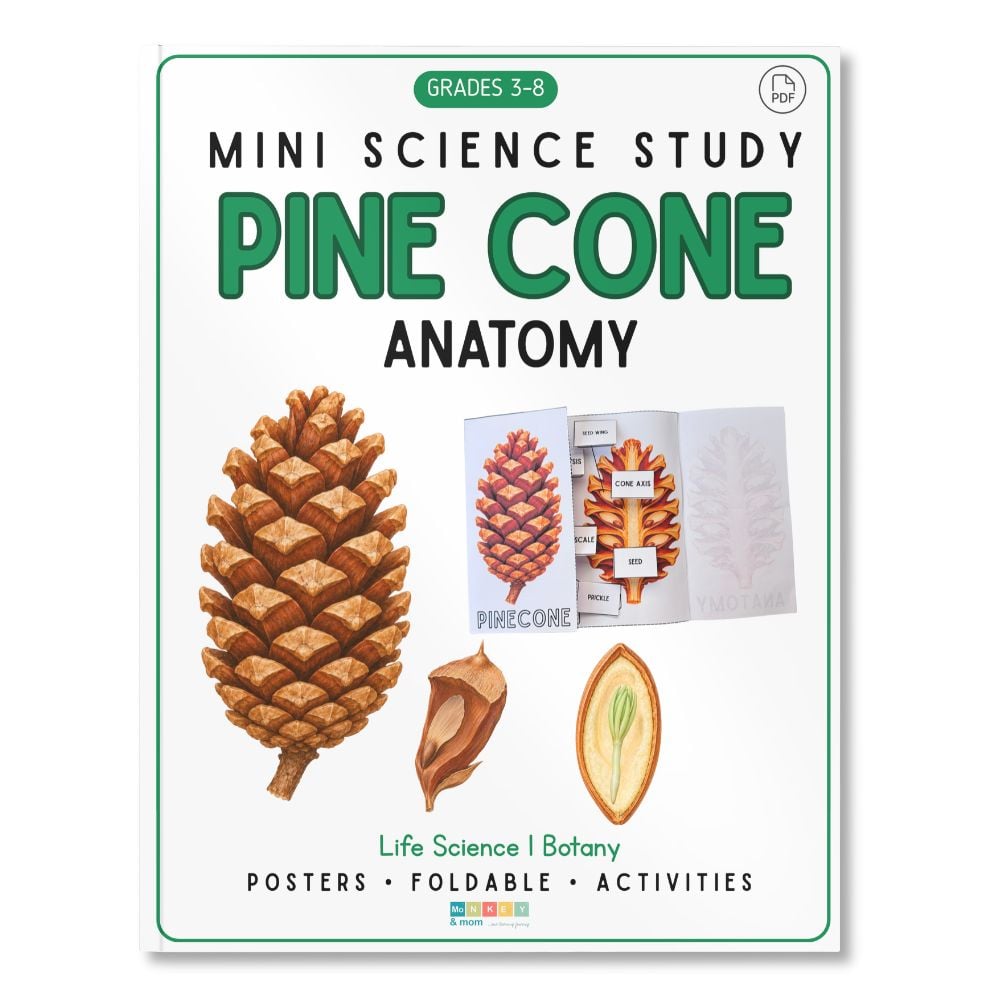
Pine Cone Anatomy Worksheets & Lift-the-Flap Models – Mini Science Study (Grades 3–8)
Explore the parts of a pine cone, discover what's inside a pine seed, and investigate how pine cones respond to moisture with this 27-page Pine Cone Anatomy Mini Science Study for Grades 3–8!
Why do pine cones open and close? Where are the seeds hidden? What is the difference between the umbo and the apophysis? And how does a tiny pine seed develop into a new tree?
Help children answer these questions through detailed botanical illustrations, interactive paper models, pine cone anatomy worksheets, coloring activities, and a hands-on science experiment.
This printable botany study introduces children to the external and internal structures of a pine cone before taking a closer look at individual seed scales, pine seeds, and the developing plant embryo.
Designed for upper elementary and middle school students, this resource can be used in your homeschool, classroom, science center, or as part of an autumn or winter nature study.
What's Included
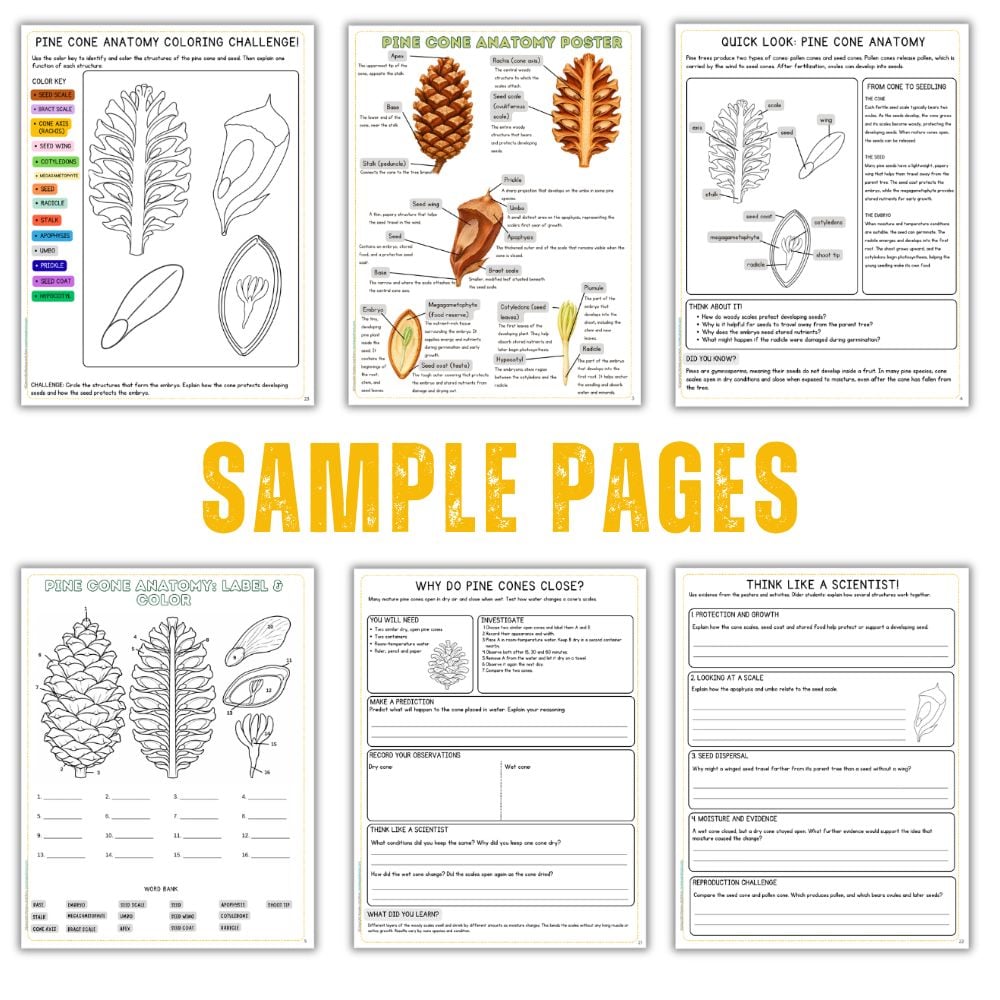
1. Illustrated Pine Cone Anatomy Poster
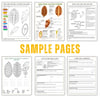
Explore five detailed botanical illustrations showing:
- External pine cone anatomy
- Longitudinal cross-section of a pine cone
- Anatomy of an individual seed scale
- Internal anatomy of a pine seed
- Parts of the plant embryo
Children learn scientific vocabulary, including the rachis, peduncle, apophysis, umbo, bract scale, megagametophyte, cotyledons, and radicle.
2. Pine Cone Anatomy Quick Guide
An illustrated information page explaining how pine cones protect developing seeds, how seeds disperse, and how germination begins. Includes comprehension and critical thinking questions.
3. Pine Cone Labeling Worksheets
Identify and label the parts of a pine cone and seed using detailed black-and-white illustrations and a vocabulary word bank.
4
. Two Interactive Lift-the-Flap Anatomy Models
Build your own interactive paper models to explore:
- Pine cone anatomy
- Pine seed and embryo anatomy
Includes full-color and black-and-white versions, vocabulary flaps, fill-in options, and step-by-step assembly instructions.
Children can lift each flap to discover the function of the corresponding anatomical structure.
5. Anatomy and Vocabulary Activities
Reinforce scientific vocabulary through structure-and-function matching, fill-in-the-blank exercises, guided exploration, and review questions.
6. Why Do Pine Cones Close? Science Experiment
Investigate how moisture affects pine cone scales using real pine cones, water, and simple household materials.
Children practice making predictions, recording observations, comparing results, and drawing scientific conclusions.
7. Pine Cone Anatomy Coloring Challenge
Use a color key to identify and distinguish anatomical structures across different botanical illustrations, including the pine cone cross-section, seed scale, winged seed, and embryo.
8. Answer Keys and Teacher Notes
Includes answers to the worksheets, suggested responses to open-ended science questions, and guidance for adapting the activities to different grade levels.
What Children Will Learn
- The external and internal parts of a pine cone
- The structures and functions of individual seed scales
- The differences between pollen cones and seed cones
- How pine cones protect and release their seeds
- How winged seeds disperse
- The internal anatomy of a pine seed
- The main structures of a plant embryo
- How moisture causes pine cone scales to open and close
- Scientific observation, reasoning, and botanical vocabulary
Perfect For
- Grades 3–8 science lessons
- Homeschool botany and nature studies
- Autumn and winter science activities
- Evergreen tree and conifer studies
- Plant reproduction and seed dispersal lessons
- Interactive science notebooks
- Hands-on elementary and middle school science
You can complete this mini-study on its own or combine it with outdoor nature walks, pine cone observations, evergreen tree identification, and other plant science activities.
Product Details
- 27-page printable PDF
- US Letter size (8.5 × 11 inches)
- Full-color and black-and-white activities
- Recommended for Grades 3–8
- Written in American English
- Digital download — no physical product will be shipped
Print the pages you need and adapt the activities to your child's learning level.
Upon purchase, you will receive access to the downloadable PDF. If you experience any problems with your file, please contact me at hello@monkeyandmom.com.