

Bundle Includes
Here are all the products that are included in your bundle
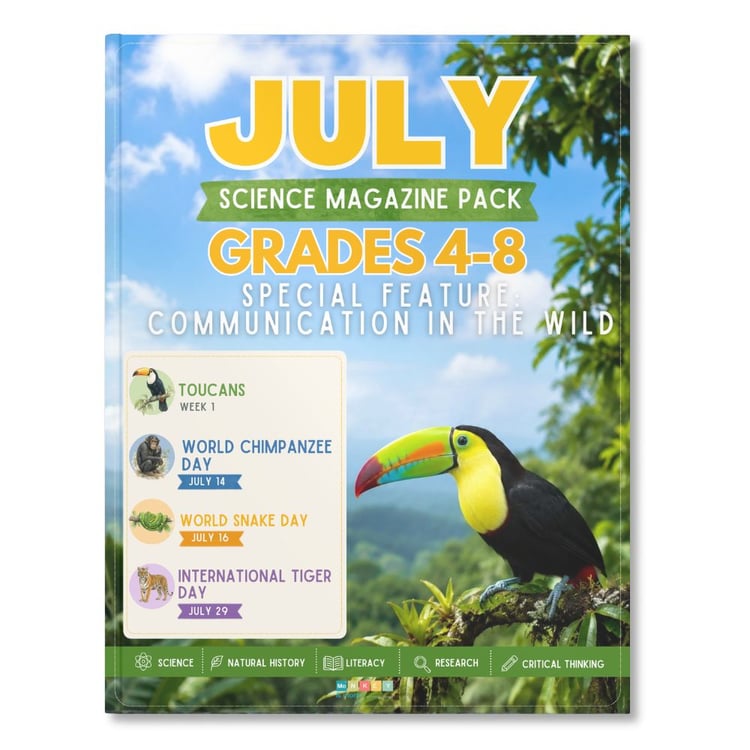
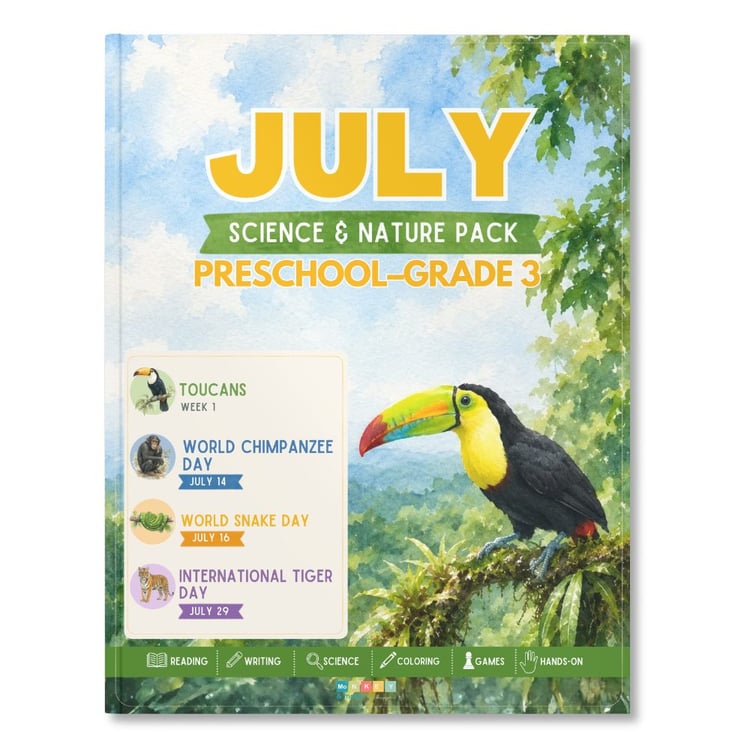
July Printable Learning Bundle
PreK–Grade 8 Science, Nature, Reading & Hands-On Activities
This is a digital printable July learning bundle for Preschool–Grade 8.
It includes the July Science & Nature Pack for Preschool–Grade 3, the July Science Magazine Pack for Grades 4–8, the matching Teacher & Parent Guide, and the bonus Rainforest Layers Micro Study.
This bundle brings July animal science, rainforest learning, nonfiction reading, vocabulary, writing, hands-on activities, research, and curiosity-led exploration together in one printable set.
Children explore toucans, chimpanzees, green tree pythons, tigers, rainforest layers, national animals, animal adaptations, and animal communication through age-appropriate pages for younger and older learners.
Includes:
- Preschool–Grade 3 July Science & Nature Pack
- Grades 4–8 July Science Magazine Pack
- July Teacher & Parent Guide
- Bonus Rainforest Layers Micro Study
- 141 printable pages total
- Digital PDF download
- No physical product will be shipped
This bundle is best for families or educators who want one July science and nature theme that can work across multiple ages.
What’s Included
This July bundle includes:
- July Science & Nature Pack for Preschool–Grade 3
- July Science Magazine Pack for Grades 4–8
- July Teacher & Parent Guide
- Bonus Rainforest Layers Micro Study
The younger pack is designed for early learners who need simple readers, tracing, coloring, labeling, handwriting, crafts, games, and hands-on activities.
The older pack is designed for curious upper elementary and middle school learners who are ready for nonfiction articles, stronger vocabulary, deeper questions, research, science writing, and project-style thinking.
The bonus micro study gives older or advanced learners a deeper look at rainforest layers, habitats, adaptations, and biodiversity.
July Themes Included
Students explore:
- toucans
- World Chimpanzee Day
- World Snake Day
- International Tiger Day
- rainforest layers
- national animals around the world
- animal adaptations
- animal anatomy
- animal communication
- camouflage
- tool use
- thermoregulation
- convergent forms
- conservation
- biodiversity
- science vocabulary
- observation and nature study
- reading, writing, and research connections
Preschool–Grade 3 Pack
The younger July pack includes:
- July month page
- undated July calendar page
- four weekly animal sections
- simple animal readers
- tracing vocabulary words
- animal fact pages
- handwriting practice
- letter practice pages
- comprehension worksheets
- animal anatomy pages
- labeling activities
- coloring pages
- color-by-number pages
- mazes
- word searches
- simple counting and math pages
- crafts
- hands-on activities or experiments
Younger learners explore toucans, chimpanzees, green tree pythons, and tigers through simple science, early reading, fine motor work, animal facts, and hands-on learning.
Grades 4–8 Science Magazine Pack
The older July pack includes:
- July overview page
- July nature days section
- national animals feature
- magazine-style science articles
- visual vocabulary pages
- diagrams and image-supported explanations
- reading response pages
- comprehension questions
- text evidence prompts
- writing prompts
- discussion questions
- investigation boxes
- research starters
- map activities
- data activities
- math connections
- project-style learning opportunities
- Communication in the Wild special feature
- crossword or review activities
- answer support where included
Older learners explore the same July themes through deeper science, nonfiction reading, vocabulary, discussion, research, and critical thinking.
Bonus Rainforest Layers Micro Study
The bonus micro study is best for upper elementary and middle school learners.
Students learn about:
- the forest floor
- the understory
- the canopy
- the emergent layer
- sunlight and shade
- rainforest microclimates
- plant adaptations
- animal life in each layer
- decomposition
- epiphytes and vines
- rainforest biodiversity
The micro study includes reading pages, response questions, vocabulary support, labeling pages, rainforest layer activities, discussion prompts, extension ideas, curated resources, and answer support.
Weekly Bundle Structure
Week 1: Toucans
Younger learners explore toucans, big beaks, rainforest life, fruit, seed dispersal, and basic bird features through readers, tracing, facts, labeling, coloring, and hands-on work.
Older learners go deeper with toucan thermoregulation, bill structure, hollow design, beta-keratin, biomimicry, fruit tossing, and rainforest adaptations.
Week 2: Chimpanzees
Younger learners explore chimpanzees as intelligent apes with hands, tools, social groups, facial expressions, and rainforest homes.
Older learners study chimpanzee tool use, Jane Goodall and Gombe, cultural transmission, gestures, memory research, fission-fusion groups, and ape vs. monkey classification.
Week 3: Green Tree Pythons
Younger learners explore green tree pythons, scales, shedding, camouflage, body parts, color change, and snake movement.
Older learners study ontogenetic color change, labial pits, infrared heat detection, constriction, prehensile tails, and convergent forms with the emerald tree boa.
Week 4: Tigers
Younger learners explore tigers as big cats with stripes, claws, tails, strong bodies, camouflage, swimming ability, and night vision.
Older learners study disruptive coloration, camera traps, tiger senses, tapetum lucidum, infrasound, conservation, tiger math, and subspecies.
Teacher & Parent Guide Included
The included guide helps adults use the bundle without planning everything from scratch.
It includes:
- monthly overview
- weekly theme notes
- background information for adults
- page-by-page teaching suggestions
- conversation starters
- discussion questions
- writing choices
- extension ideas
- hands-on activity ideas
- simple project suggestions
- vocabulary support
- QR-coded videos, books, articles, and enrichment resources
- ways to adapt the pages for different ages
- ideas for homeschool, co-op, classroom enrichment, independent work, and summer learning
Start with the guide if you want help choosing pages, pacing the month, supporting different ages, or turning the activities into discussion, research, writing, and hands-on learning.
How to Use This Bundle
This bundle is a celebration of science, nature, animals, and curiosity. It is not a scripted curriculum or a checklist.
You can use one animal each week, focus on the topics your children love most, skip topics that do not interest them, or use the bundle as a launchpad for books, videos, research, nature study, library trips, and further exploration.
You do not need to complete every page.
Some families may use the full bundle across the month. Others may choose only a few pages per topic. Both are fine.
For children between levels, you can move up for ideas and move down for output. Read the older articles aloud, discuss the ideas together, and use the younger pages for simpler written work, coloring, labeling, or hands-on activities.
Skills Practiced
Across the bundle, students may practice:
- early reading
- informational reading
- listening comprehension
- vocabulary
- tracing and handwriting
- reading comprehension
- written response
- text evidence
- observation
- animal anatomy
- labeling
- simple math
- science vocabulary
- science explanation
- comparing ideas
- cause and effect
- research skills
- discussion
- project planning
- fine motor skills
- critical thinking
- independent learning
Best For
This bundle works well for:
- mixed-age homeschool families
- preschool through grade 8 learners
- classroom teachers
- co-op teachers
- summer learning
- morning basket
- science enrichment
- nature study
- animal science units
- rainforest studies
- early finishers
- classroom extension work
- independent learning
- curious and gifted learners
- families who want one seasonal theme across multiple ages
Some children may work independently. Others may need adult support, read-aloud help, discussion, or adapted activities. Choose the pages and level of support that fit your learner.