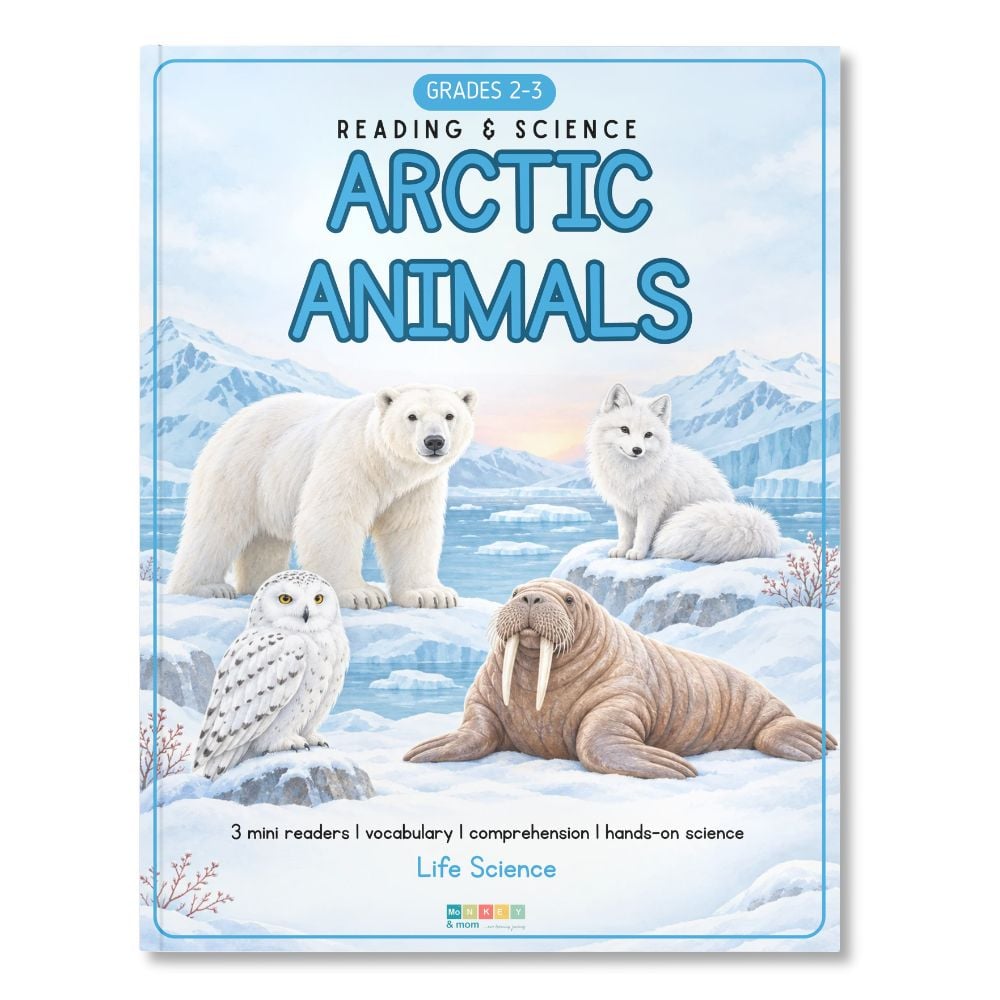
Arctic Animals Reading & Science | Grades 2–3
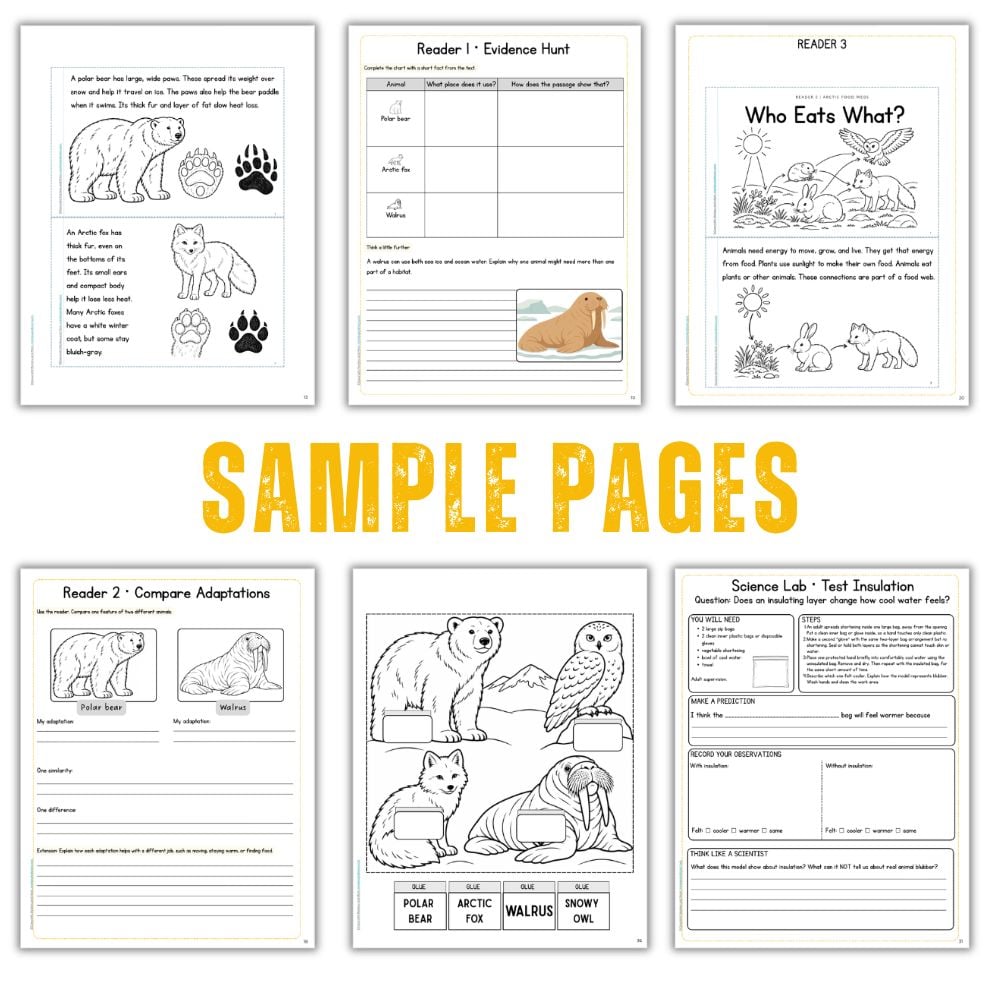
38-page printable Arctic Animals mini unit study featuring three nonfiction mini-readers, vocabulary exercises, reading comprehension, animal adaptations, food webs, a hands-on science experiment, and an interactive foldable.
Arctic Animals Reading & Science for Grades 2–3
Help children build nonfiction reading skills while exploring Arctic animals and the environments they live in.
This reading and science mini unit study combines three illustrated mini-readers with vocabulary practice, comprehension questions, text-evidence activities, and hands-on science investigations.
Children begin by learning about the Arctic region, including the tundra, Arctic Ocean, and sea ice. Next, they investigate the adaptations that help animals survive in cold environments. Finally, they explore predators, prey, food chains, and the relationships between living things.
Each reading is followed by meaningful activities that encourage children to revisit the text, find information, explain scientific concepts, and apply what they have learned.
What's Included
1. Parent & Teacher Support
- Parent and teacher guide
- Suggested four-session teaching sequence
- Reading support and differentiation for Grades 2–3
- Science vocabulary reference
- Answer keys and teacher notes
2. Three Nonfiction Mini-Readers
Reader 1: A Place Called the Arctic
Explore the Arctic region, including its ocean, sea ice, and tundra habitats. Discover where different Arctic animals live and how they use their environments.
Reader 2: Built for the Cold
Learn how polar bears, Arctic foxes, Arctic hares, snowy owls, and walruses survive through adaptations such as thick fur, insulating fat, feathers, camouflage, and specialized body features.
Reader 3: Who Eats What?
Investigate Arctic feeding relationships, including predators, prey, food chains, and food webs. Discover how different animals depend on other living things for food.
Each illustrated reader contains 10 small book pages arranged for printing, cutting, and stapling.
3. Reading Comprehension & Vocabulary
Activities include:
- Identifying main ideas and supporting details
- Finding evidence in nonfiction texts
- Understanding science vocabulary in context
- Matching scientific terms to definitions
- Comparing Arctic animals and their adaptations
- Making inferences from information in the readings
- Answering comprehension questions
- Explaining scientific concepts in complete sentences
- Understanding predator and prey relationships
4. Hands-On Science Activities
Animal Adaptation Matching Cards
Match five Arctic animals with features that help them survive and explain how each adaptation works.
Build an Arctic Food Web
Cut out animal and food picture cards, arrange feeding relationships, and draw arrows to show how energy moves through food chains and food webs.
Blubber Insulation Experiment
Explore how insulation slows heat loss through a simple, adult-supervised investigation using an insulating layer. Children make predictions, record observations, and discuss the results.
Arctic Animal Adaptations Foldable
Create an interactive lift-the-flap paper activity to review Arctic animals and their adaptations.
Skills Practiced
This printable helps children develop:
- Nonfiction reading comprehension
- Science vocabulary
- Identifying main ideas and supporting details
- Comparing and contrasting
- Using text evidence
- Making inferences
- Scientific observation and recording
- Understanding habitats and animal adaptations
- Exploring food chains and food webs
- Explaining information through writing and discussion
Designed for Grades 2–3
This resource is intended for elementary students developing confidence with nonfiction reading and scientific vocabulary.
Grade 2: Children may benefit from shared reading, oral discussion, vocabulary support, and help writing complete sentences.
Grade 3: More confident readers can work independently, find supporting evidence in the text, and write more detailed explanations.
The mini-readers contain informational science text and are not designed as fully decodable phonics readers.
Flexible for Homeschool & Classroom Learning
Use this mini unit study over four short sessions, or choose individual readings and activities to complement your existing science and literacy curriculum.
Suitable for homeschooling, elementary science lessons, literacy centers, small-group instruction, nonfiction reading practice, winter studies, and Arctic animal science.
File Details
Format: Printable digital PDF
Length: 38 pages
Grades: 2–3
Subjects: Reading, Vocabulary, Comprehension, Life Science
Topics: Arctic Habitats, Animal Adaptations, Food Chains & Food Webs
Includes: Three nonfiction mini-readers, reading and vocabulary worksheets, hands-on activities, an insulation experiment, an interactive foldable, and teacher answer keys
Paper Size: US Letter (8.5 × 11 inches)
Digital Download Notice
This is a digital download. No physical product will be shipped.
Due to the digital nature of this product, all sales are final. Refunds, returns, and exchanges are not accepted.
If you have trouble downloading, opening, or accessing your file, please contact me at hello@monkeyandmom.com, and I will be happy to help.